
If you’re using HubSpot for sales, knowing how to create and edit lists is essential. Lists play an integral role in organizing data and segmenting contacts based on buyer personas, engagement history, purchase behavior, and more.
Using lists, you can personalize your messages and campaigns to resonate with distinct groups, boosting engagement and conversion rates! Unfortunately, navigating the process of creating lists in HubSpot can be puzzling.
In this article, we’ll take you through the process of creating, editing, and managing lists in HubSpot. Let’s begin!
You can use Bardeen to create tickets and automate those repetitive tasks!
In HubSpot, a list is a curated grouping of contacts or companies based on specific criteria. These criteria can range from demographic data like age or location to behavioral data such as website interactions or purchase history.
Lists enable you to treat each contact in a unique way and tailor your marketing efforts for maximum results. For instance, you can create a list dedicated to new leads and assign them to a lead nurturing workflow.
Sounds great, doesn’t it? When creating lists in HubSpot, you need to choose between an Active and Static list. Let’s define both of them.
Active lists, also known as dynamic or smart lists, are dynamic segments of contacts or companies that automatically update based on predefined criteria or conditions that you set. For example, you can create an active list for sending unique marketing emails based on the behavior and properties of each contact.
Whereas active lists are automated, static lists require you to put contacts or companies inside it manually. Once you create a static list and add contacts, they remain there until you remove them.
Be sure to choose which type of list you want to create based on your specific use case. Now, without further ado, let’s go through the steps to create a list in HubSpot.
Here are the steps to create a list in HubSpot.
Step 1: Click Contacts in the top-left corner of the screen and Lists in the drop-down menu.

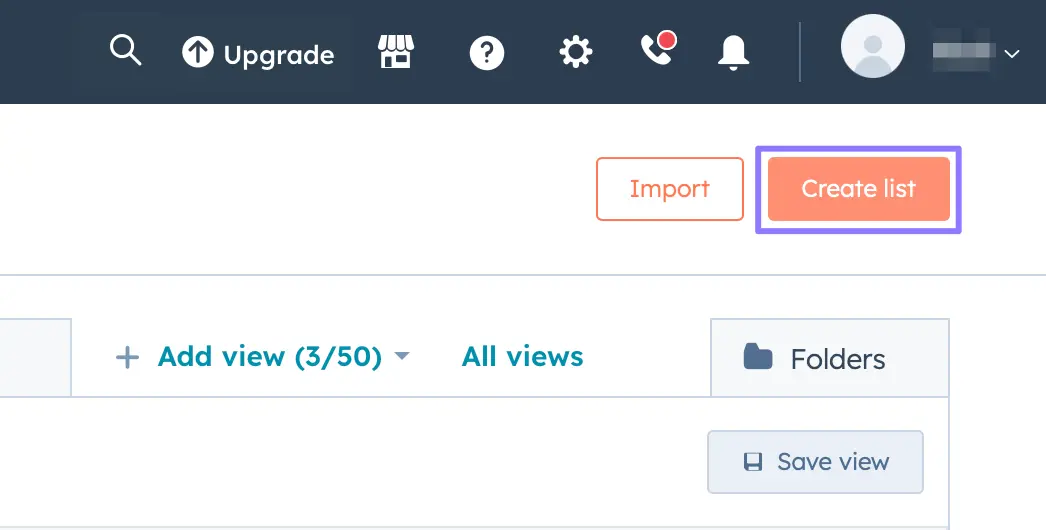
Step 2: Click Create list.
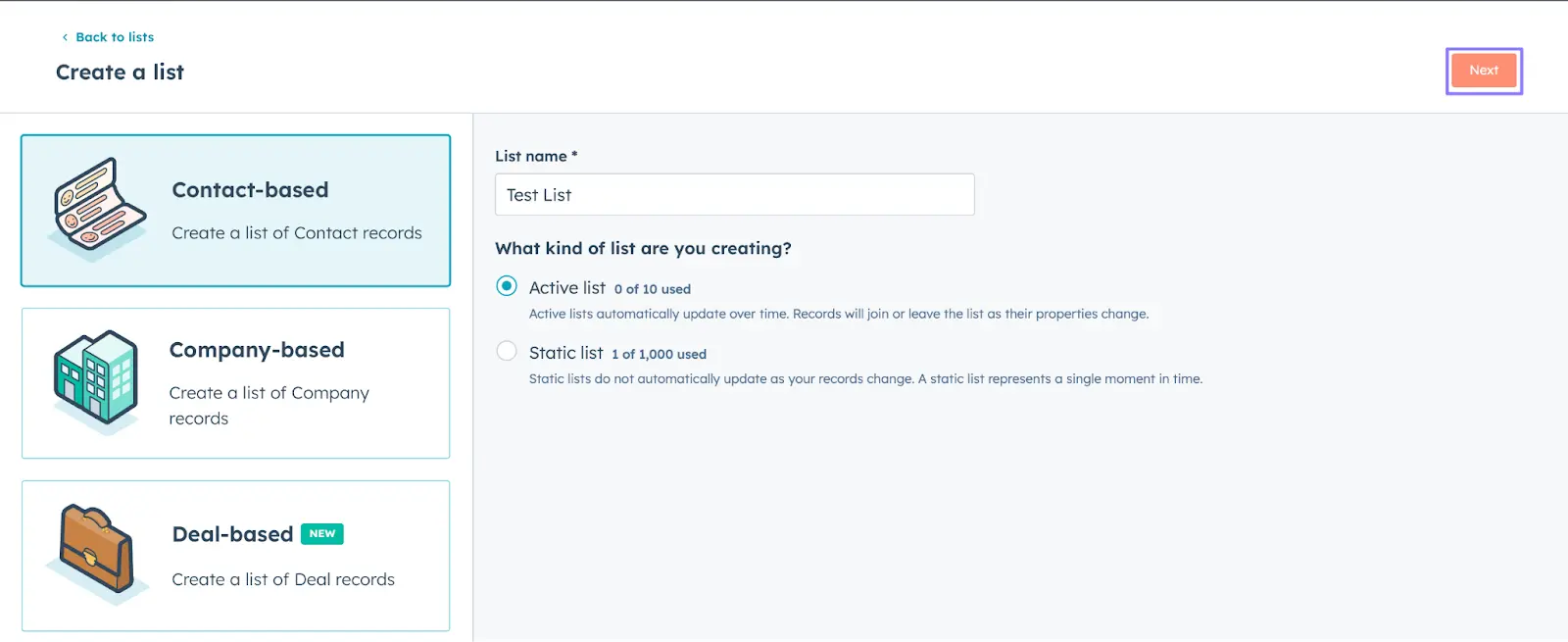
Step 3: In the left panel, select Contact-based, Company-based, or Deal-based based on what type of list you want to create.
Step 4: Enter the list name and select if you want an active or static list. Click Next.
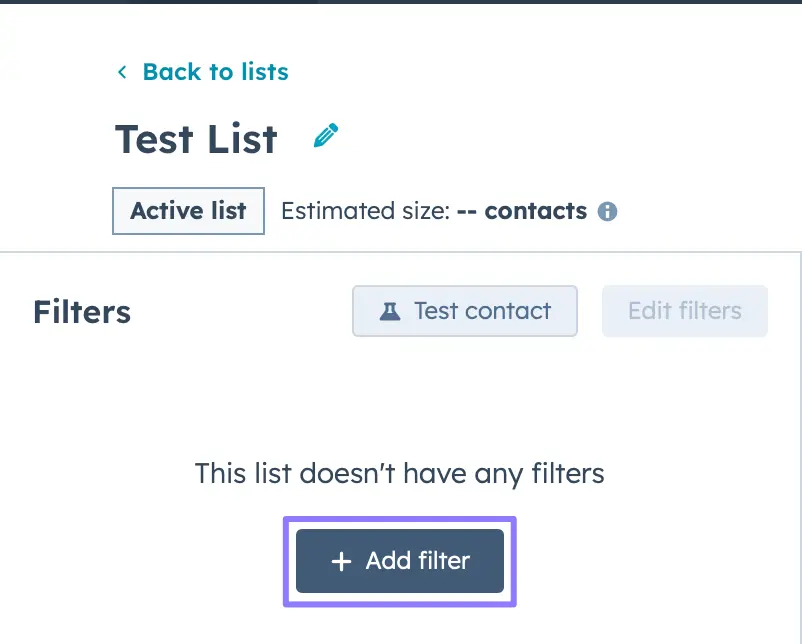
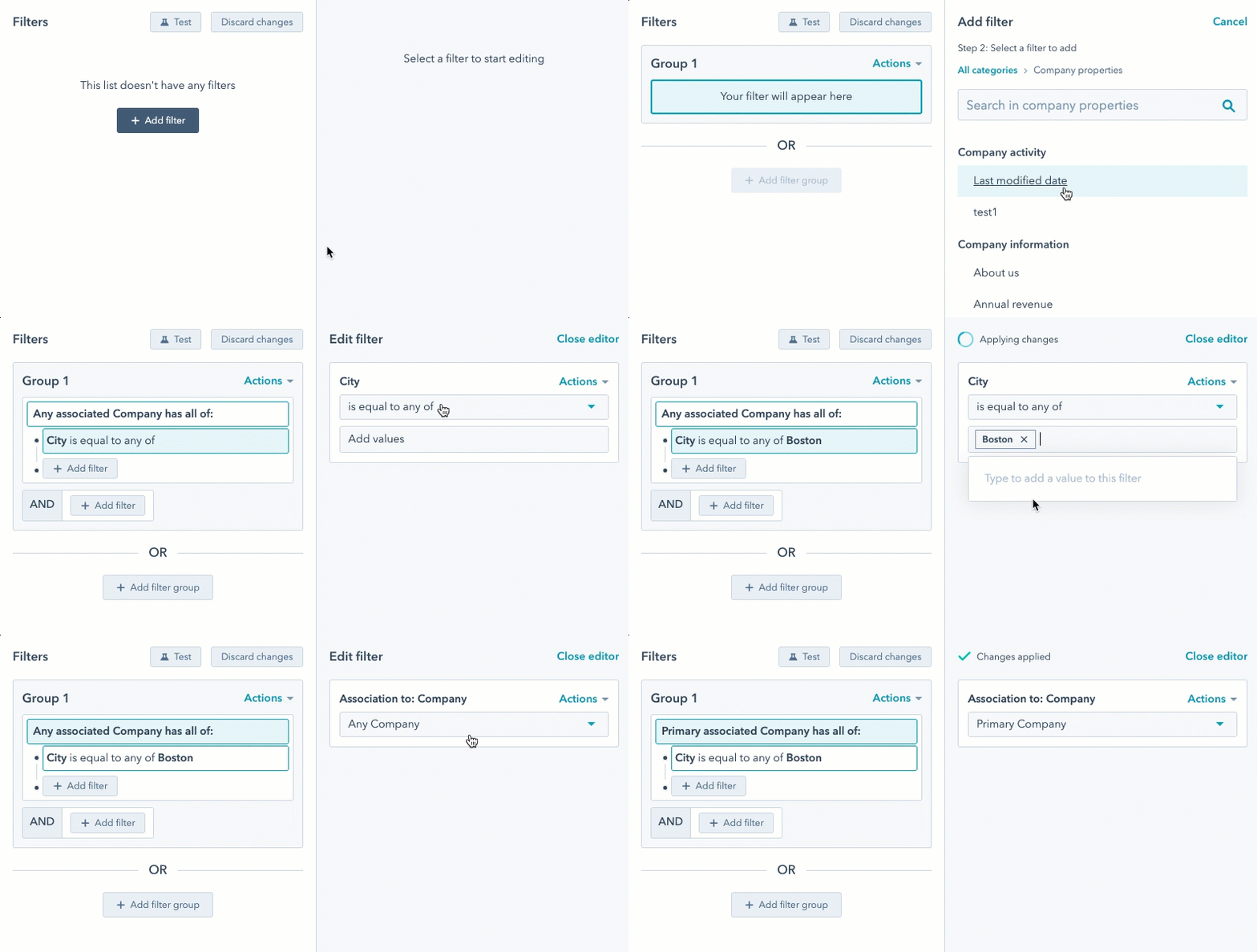
Step 5: Now, click Add filter to define the criteria for categorizing your contacts or companies into relevant segments. First, select a filter category and then select the property or activity to filter by.
Step 6: You can add up to 250 filters per list, so feel free to fine-tune it as necessary. Consider demographics, behavior, or engagement. Check this HubSpot knowledge page to learn more about list criteria.
Step 7: HubSpot will generate a preview of the list once you enter the criteria. Go through it to ensure the filtering conditions accurately capture your intended audience. Make adjustments if necessary and click Save list.
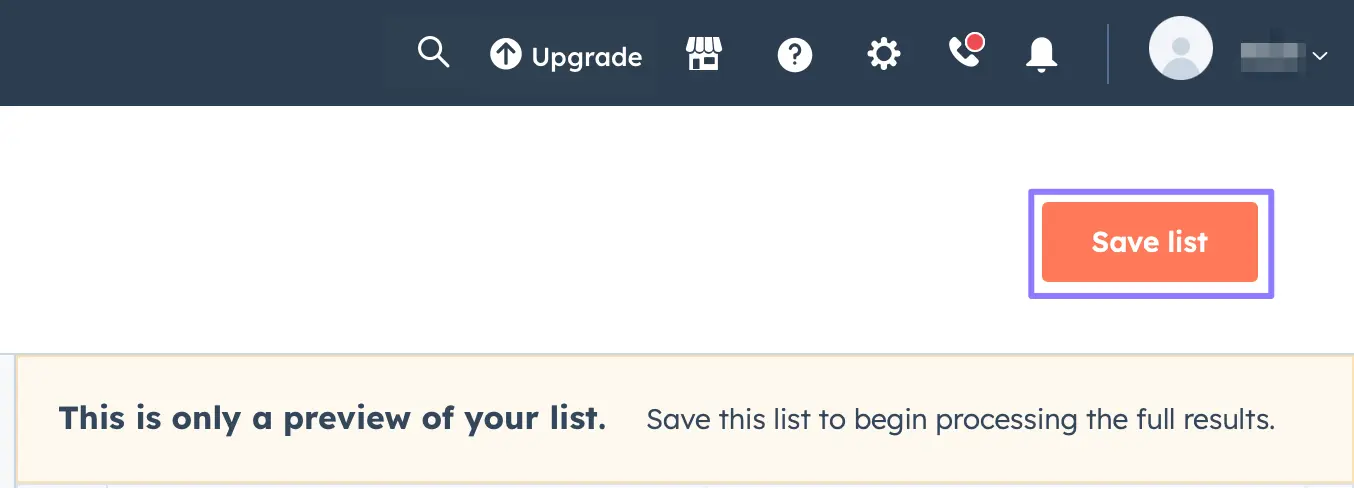
Congratulations on creating your first list! You can access all your lists by clicking Contacts in the top-left corner of the screen and Lists in the drop-down menu.
Now that you know the steps to create a list, let’s go through three common scenarios for creating lists in HubSpot.
Here’s how you can create a list of all your contacts. First, go to your Lists home screen, click Create list, choose Contacts-based, add a list name, and make it an Active list. Click Next and follow these steps.
Step 1: Click Add filter.
Step 2: Select Contact properties under Filter category.
Step 3: Search for and select Create date.
Step 4: In the dropdown menu, select is known. Click Save list once done.
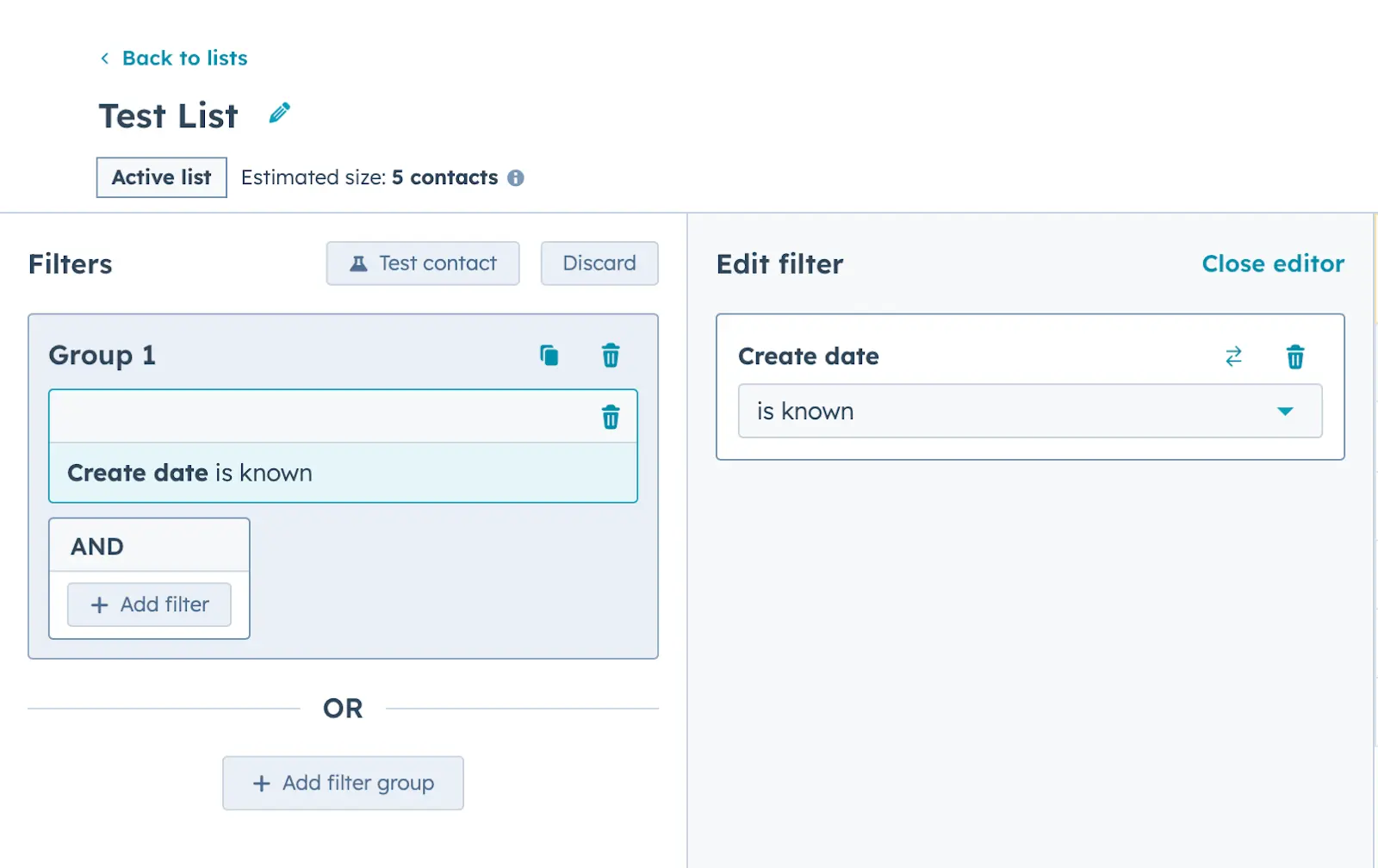
Feel free to experiment and create variations of this filter based on your requirements. Whenever a new contact that fulfills the criteria is created, it’ll be added to the list without any manual work needed!
To create a list of unsubscribed contacts, you can create a Static or Active list where the contact property Unsubscribed from all email is equal to True. Here are the steps to do it.
Step 1: Go to your Lists home screen, click Create list, choose Contacts-based, add a list name, and make it an Active or Static list. Click Next.
Step 2: Click Add filter. Select Contact properties under Filter category.
Step 3: Search and select Unsubscribed from all email. Select True. This is how it should look. In the upper right corner of the screen, click Save list.
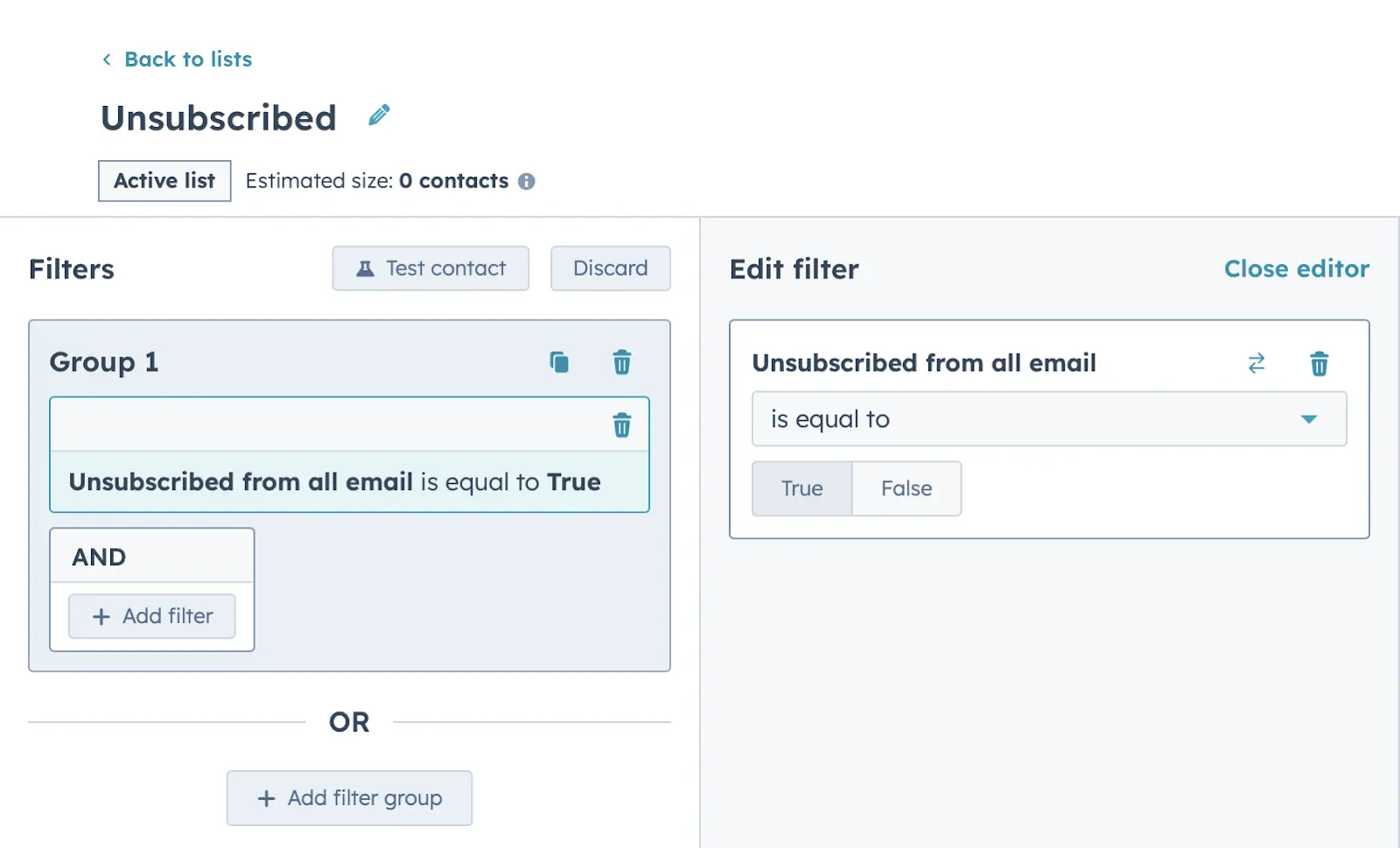
Check this HubSpot page to learn more about deleting contacts who don’t receive your marketing emails.
Unlike active lists, static lists aren’t automated, but they are suitable for creating specific, one-time segments that are unlikely to change over time. Here’s how to add contacts to a static list.
Step 1: Click Contacts in the top-left corner of the screen and Contacts in the drop-down menu.
Step 2: Select the contacts you want to add to your static list.
Step 3: Click More and select Add to static list.
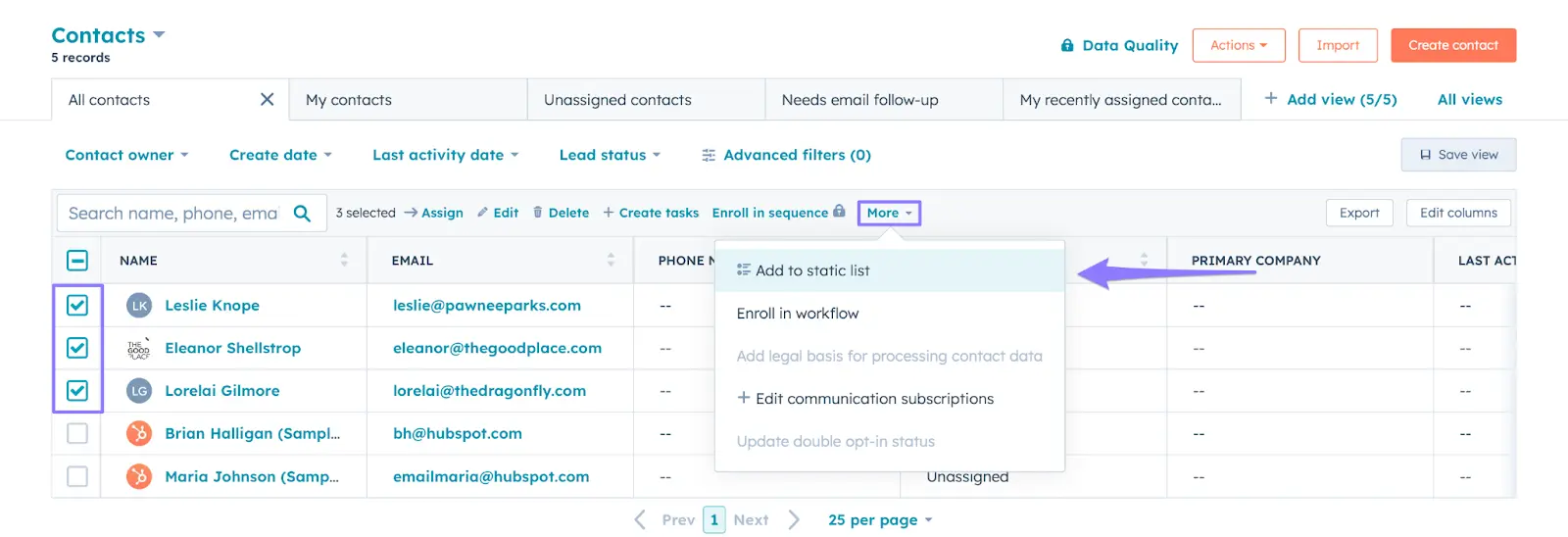
Step 4: Choose the static list you want to add the contacts to and click Add.
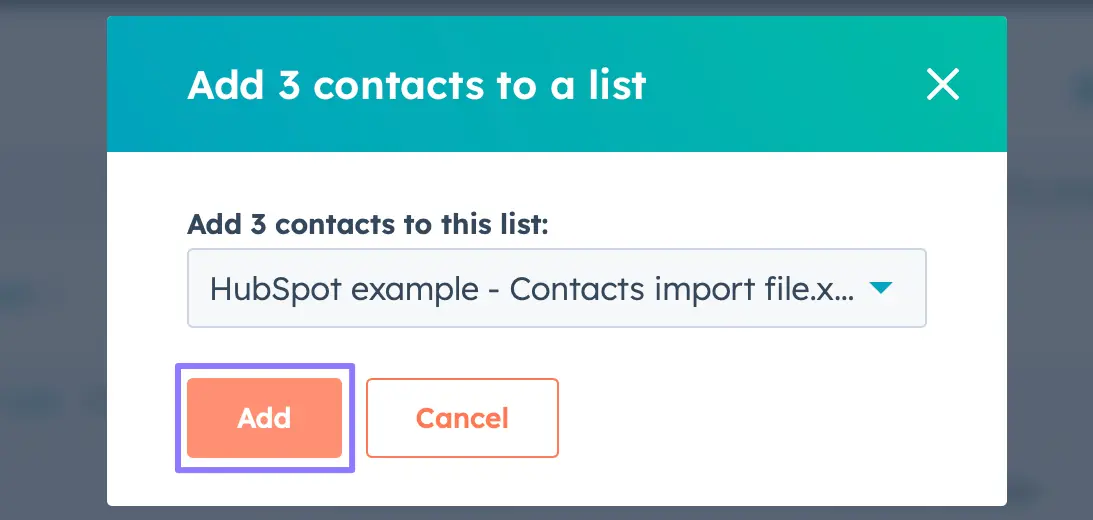
So, that’s how you can add contacts to a static list in HubSpot. If you want to remove contacts from a static list, go to your Lists home screen, open the list, and make the required changes.
Once you start creating many lists, knowing how to manage them is essential. To do this, click Contacts in the top-left corner of the screen and Lists in the drop-down menu.
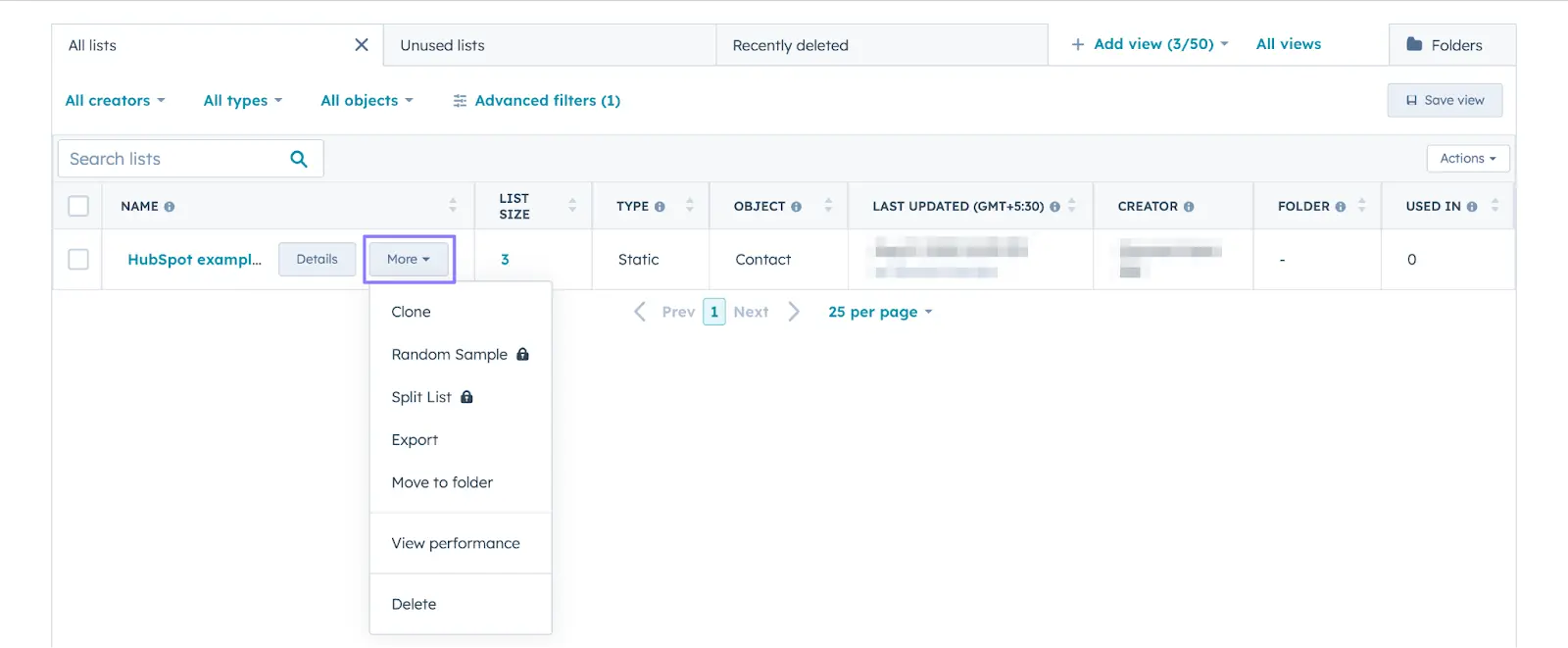
Hover over any list you want to manage and click the More dropdown menu. Here, you can clone, export, delete, or move a list to a folder for better organization. Be sure to manage lists regularly to keep them well organized.
With the impressive variety of features available in HubSpot, the marketing and sales possibilities are almost endless. However, there is only so much that you can do manually until you hit a plateau. This is where Bardeen comes in.
An AI-powered workflow automation extension for Chrome, it lets you create an automated workflow with a few lines of text. Bardeen is integrated with HubSpot and all your favorite apps, like Salesforce, Pipedrive, and Google Sheets . Bardeen enables you to connect these apps and automate tasks.
You can build your own automations using text prompts with Magic Box, and we also have many pre-built automations that you can use right away. Here are a few time-saving HubSpot automations in Bardeen.

If you have a Google Sheets spreadsheet with a list of email addresses, you can use this automation to enrich it with HubSpot company info. It fetches details like company name, industry, and contact information, supercharging your data enrichment efforts. Check this article for more Google Sheets automations.

If you received an email from a potential customer and want to add them to your HubSpot contacts, use this automation instead of doing it manually. In just a few clicks, it extracts contact details using AI and creates a HubSpot contact. Explore more HubSpot and Gmail integrations.
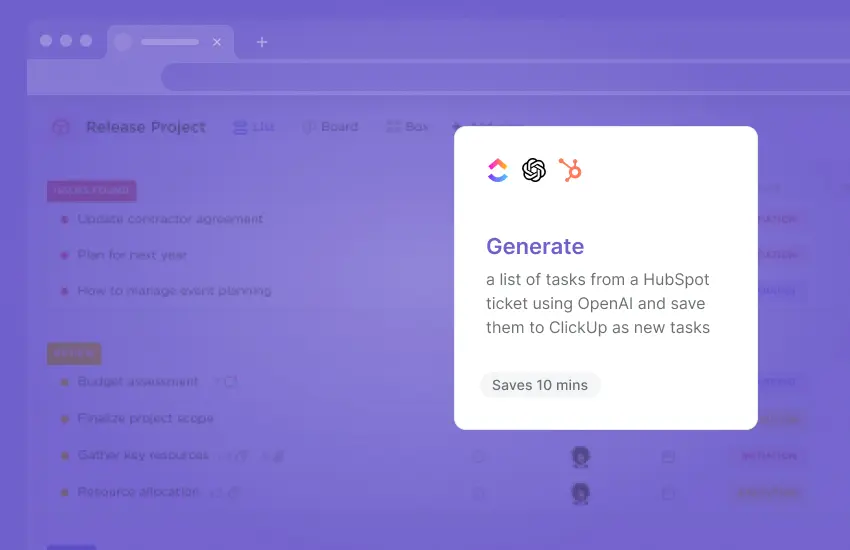
Transform HubSpot tickets into a list of tasks in ClickUp using this AI-powered automation, streamlining task assignment. This automation is available for Asana as well. You can also find more HubSpot automations and integrations.
Duplicate contacts and companies in HubSpot can often hamper your marketing efforts. Check these articles to learn how to merge contacts and companies in HubSpot.
Lists are essential if you have hundreds or thousands of contacts and companies in HubSpot. They help you segment your audience and target them for better results. Follow the above steps and create a list in HubSpot.
After you’ve created a list, you may want to export it to another platform for further use. Next, read this article to learn how to export contacts from HubSpot.







SOC 2 Type II, GDPR and CASA Tier 2 and 3 certified — so you can automate with confidence at any scale.