
When you add new contacts to HubSpot, duplicate contacts can accumulate for many reasons: manual entry errors, imports from different sources, or multiple form submissions. This can lead to miscommunication, wasted resources, and an inaccurate understanding of customer interactions.
The solution: remove duplicate contacts by merging them! Fortunately, merging contacts in HubSpot is relatively easy once you know the steps. In this article, we’ll show you two ways to merge contacts in HubSpot to maintain data cleanliness and ensure accurate customer insights. Read on to learn more.
Effortlessly streamline your HubSpot contacts by utilizing Bardeen to merge and organize your contacts with ease, saving you time and enhancing your CRM efficiency.
When you merge contacts, the primary contact takes precedence over the secondary contact. Overall, the primary contact adopts the most recent value for each property. You can check this HubSpot page for more details. Now, let’s look at the two ways to merge contacts in HubSpot.
Visit this article if you are looking to merge companies in HubSpot.
Here are the steps to use the ‘Merge’ action in HubSpot. Remember, once you merge contacts, you can’t unmerge them. So, be careful before following these steps.
Step 1: Click Contacts in the top-left corner of the screen and Contacts in the drop-down menu.

Step 2: Select the contact that you want to keep as primary.
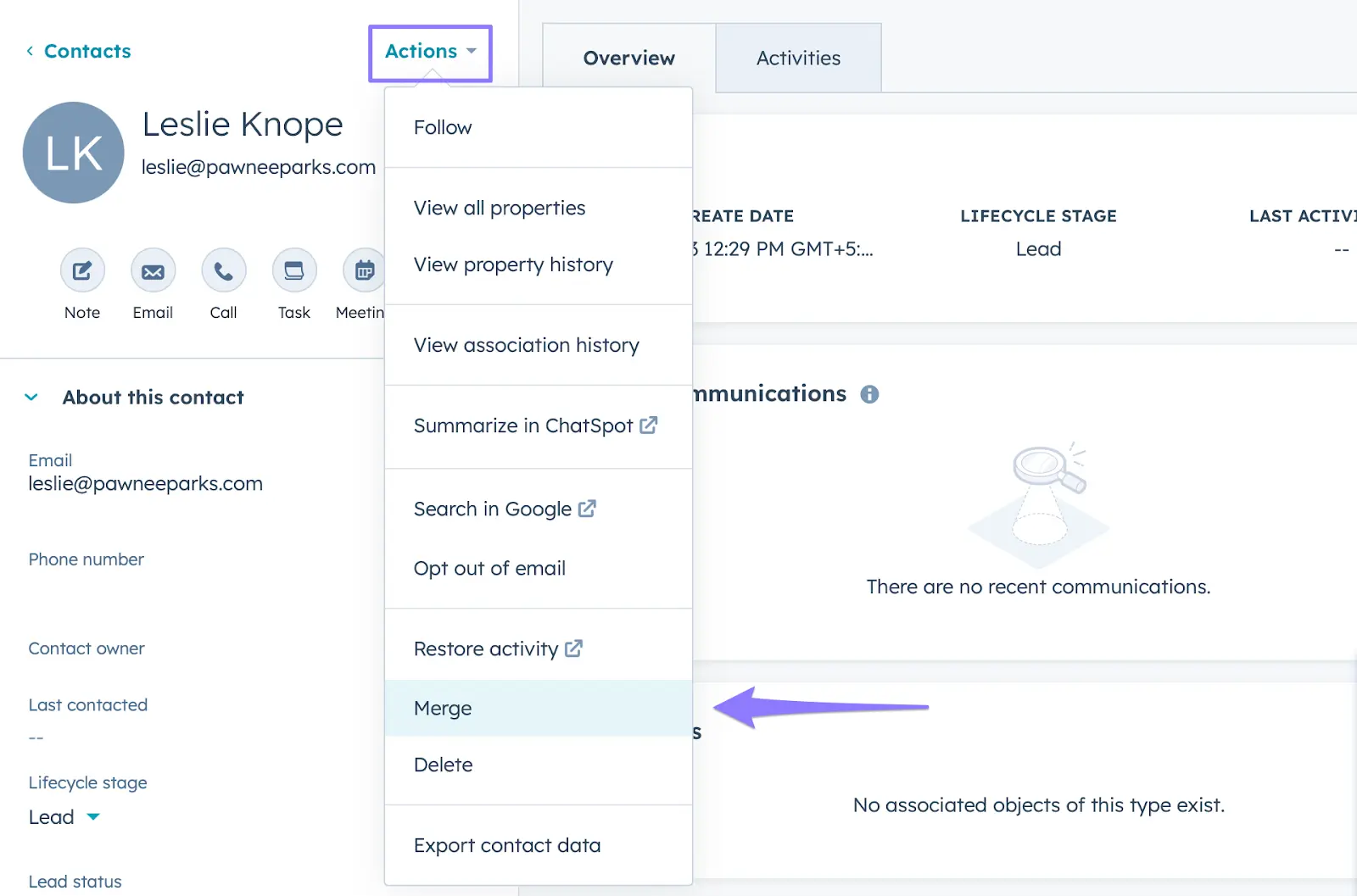
Step 3: Click Actions and select Merge.
Step 4: In the dialog box, click Search and select the secondary contact. Click Merge.
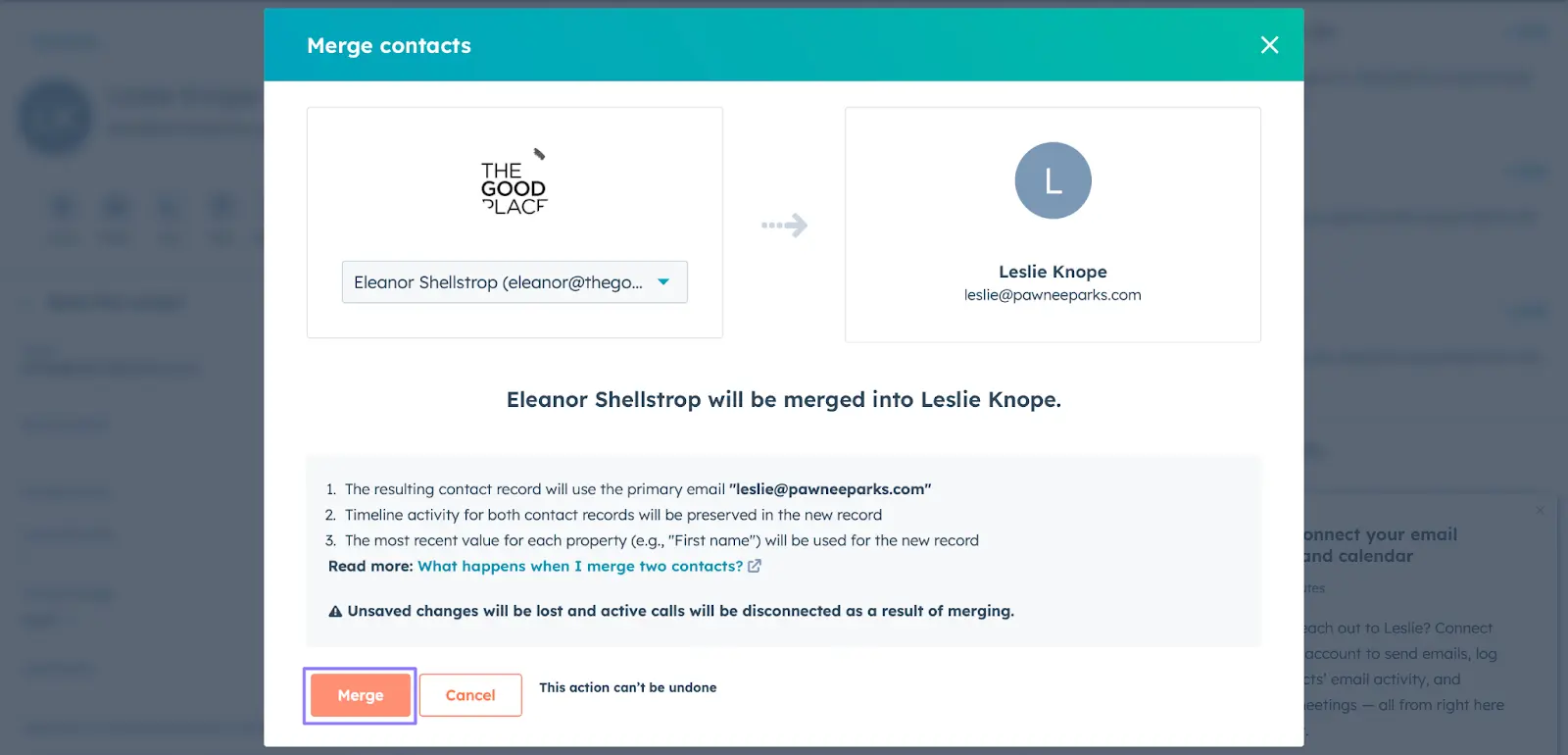
That’s it! Now, you’ll find a merge event in the activity of the contact. We recommend you review the contact and make necessary adjustments if needed.
To prevent future duplicates, establish data entry protocols and conduct routine database cleanups.
Plus, educate your team on the importance of accurate data input to maintain a duplicate-free contact database.
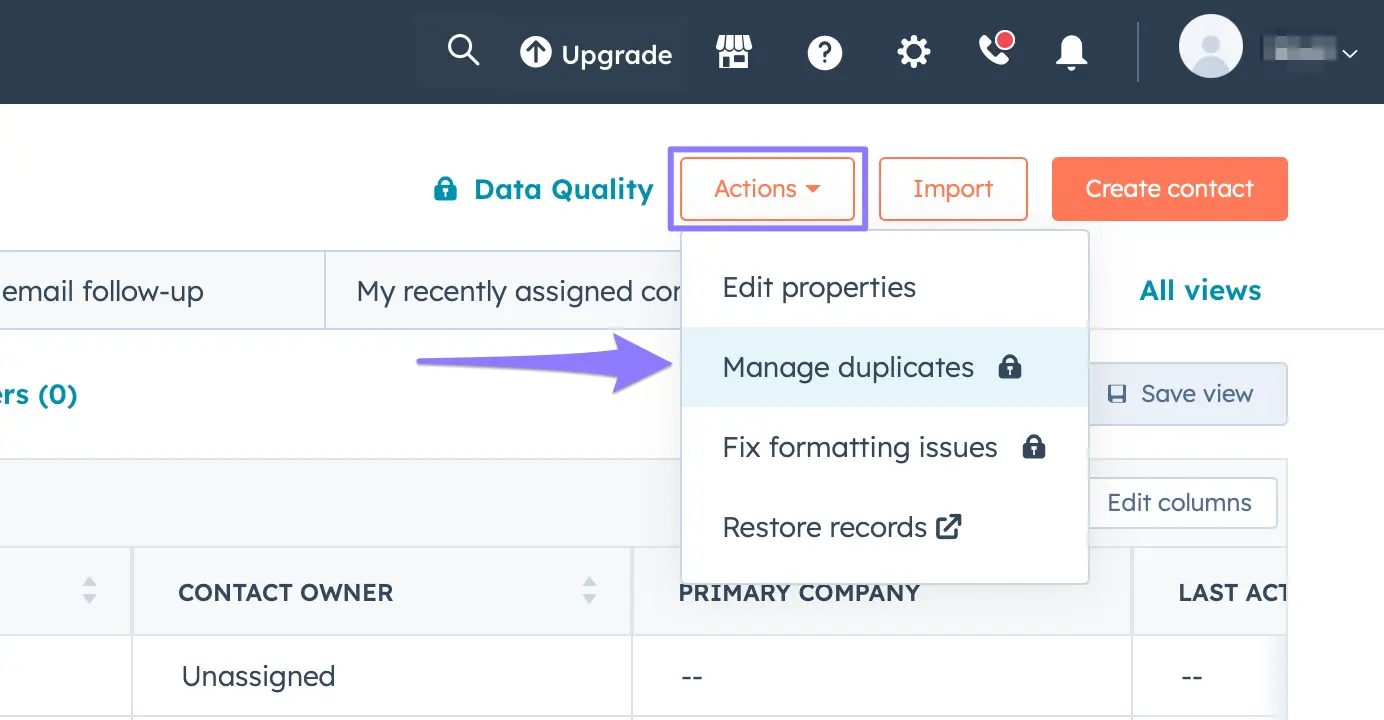
If you have Operations Hub Professional or Enterprise, you can skip the time-consuming process of finding and merging contacts manually. Go to the Contacts home screen, click Actions, and select Manage duplicates.
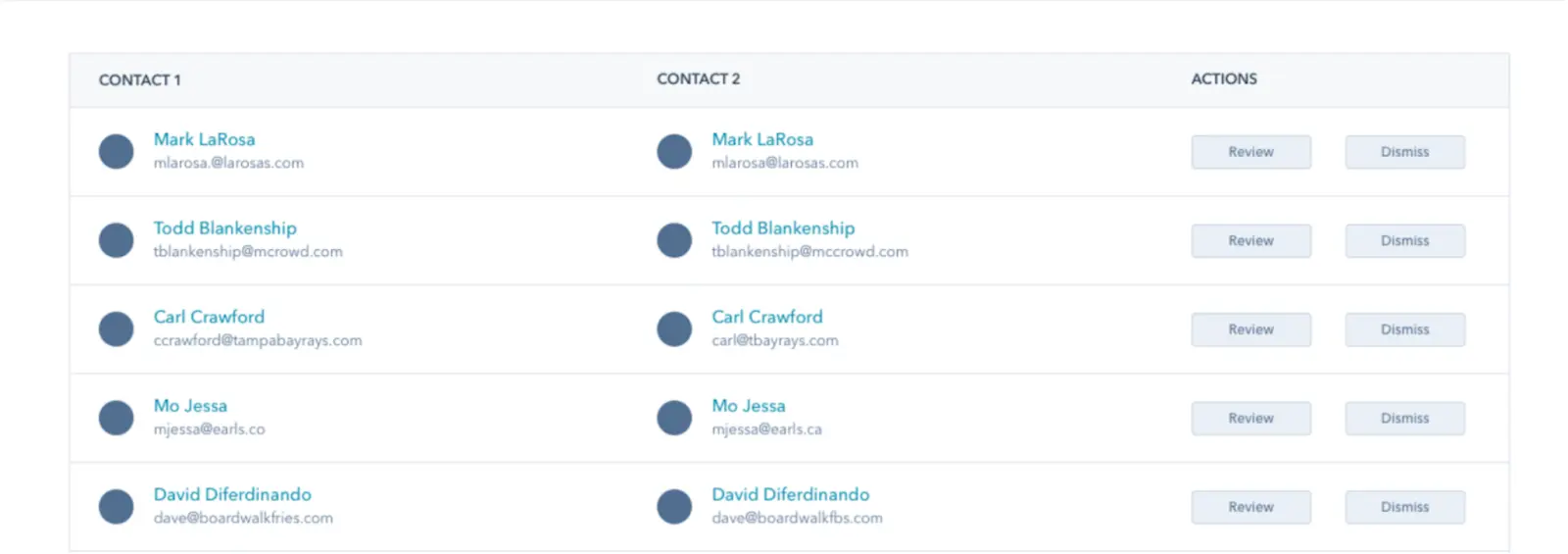
This feature uses AI to spot pairs of duplicate contacts and present them in a list. It’s also helpful if you want to mass-merge contacts. You can assess the data, select the primary contact, and merge them. You can also reject pairs.
Check this article to learn more about other helpful HubSpot features for sales.
As we saw above, bringing the power of AI to your everyday workflows can help you automate repetitive tasks and save time. For this, you can use Bardeen, an AI-powered workflow automation extension in Chrome.
Bardeen is integrated with HubSpot and over fifty popular apps and websites. The list includes Salesforce, Pipedrive, Notion, Google Sheets, and many more. Once you install Bardeen in Chrome, you can automate tasks and connect apps.
With Bardeen, you can easily create custom automations via text using AI. However, there are hundreds of pre-built workflows you can use as well. Here are some AI-powered HubSpot automations to try out.
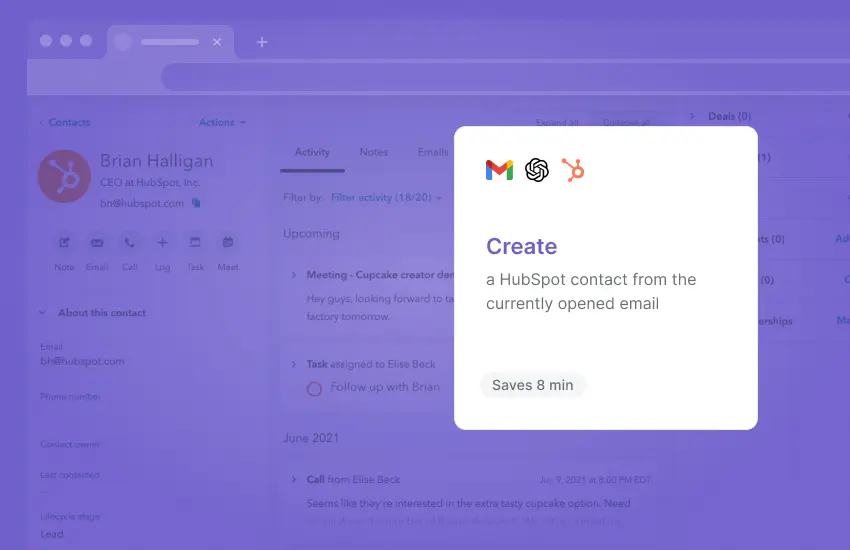
As noted above, one of the main reasons for the accumulation of duplicate contacts in HubSpot is manual entry errors. The best way to mitigate this is to let AI handle the process. With this automation, you can create a HubSpot contact from the currently opened email using AI. Learn more about HubSpot and Gmail integrations.

It can be time-consuming to reply to each HubSpot ticket from scratch manually. Instead, this automation asks for a prompt and scans the ticket to generate a response. It can save time while minimizing errors, enhancing customer support efficiency and satisfaction.

Using AI, this automation transforms a HubSpot ticket into a well-organized task list in ClickUp.
Each ClickUp task will also include the ticket content, priority level, stage, and a link to the HubSpot ticket for quick reference. Learn more about HubSpot and ClickUp integrations.
We hope you liked these automations! If you want to explore the time-saving possibilities of Bardeen, check this article for more HubSpot automations.
Each duplicate contact represents a missed opportunity to understand your audience better and provide a personalized experience. By following the above steps, you can efficiently merge contacts in HubSpot. So, go ahead and try it now.
One of the best ways to minimize duplicate contacts is to know how to import contacts to HubSpot correctly. Check this article to learn how to import contacts into HubSpot.







SOC 2 Type II, GDPR and CASA Tier 2 and 3 certified — so you can automate with confidence at any scale.